
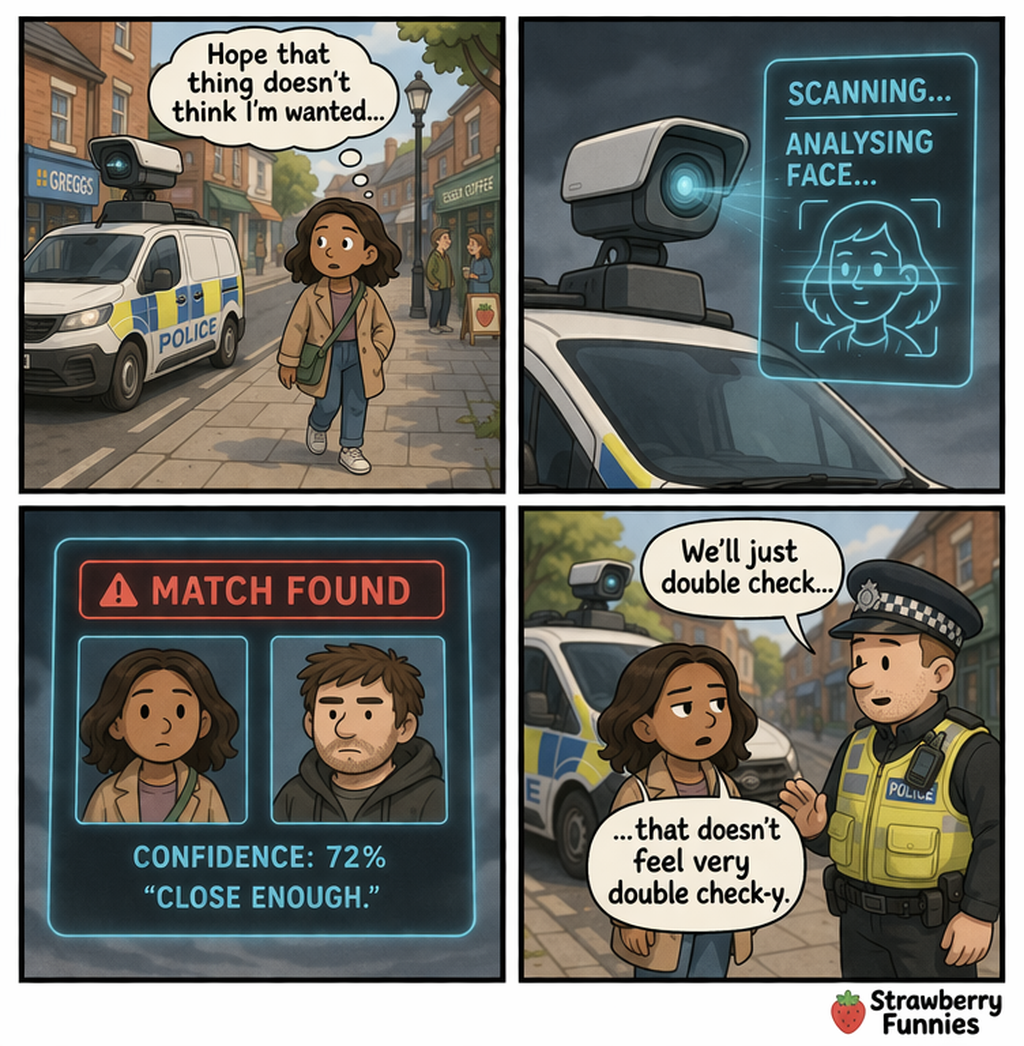
Residents across Essex may have noticed fewer of the police vans equipped with facial recognition cameras recently – and now we know why.
Essex Police have temporarily paused the use of live facial recognition (LFR) technology following concerns that the system may not treat everyone equally.
The move comes after testing suggested the software could perform differently depending on race and gender, raising questions about fairness in how the technology is used in real-world policing.
What is live facial recognition?
Live facial recognition uses cameras, often mounted on police vans, to scan faces in public spaces and compare them against a watchlist of wanted individuals.
If a match is flagged, officers nearby can step in and check the person’s identity.
It’s been used at events, busy town centres, and transport hubs across the UK, including parts of Essex.
What were the concerns?
Testing found that while the system was generally accurate, there were some imbalances:
- It was more likely to correctly identify Black individuals
- It performed better for men than women
- Overall accuracy sat at around 50% for watchlist matches
False matches were rare, but experts say the issue isn’t just about mistakes, it’s about consistency across different groups.
In simple terms: if a system works better for some people than others, it raises questions about fairness.
What happens now?
Essex Police say they:
- Paused use of the technology
- Worked with the provider to update the system
- Carried out further testing
They’ve said they’re now confident improvements have been made — but will continue to monitor its performance closely.
Why it matters locally
While this might sound like a big, abstract tech issue, it has real-world implications for communities across Essex.
Facial recognition is becoming more common in policing, particularly in busy public areas, so how fairly it works matters.
For residents in places like Tiptree, Witham, Maldon and Colchester, it raises a simple question:
How comfortable are we with this kind of technology being used in our communities?
The bigger picture
This isn’t the first time facial recognition has come under scrutiny in the UK.
Supporters say it helps police work faster and keep people safe.
Critics argue it risks reinforcing bias and increasing surveillance.
As the technology continues to develop, finding the balance between safety and fairness is likely to stay firmly in the spotlight.
Got thoughts?
Have you seen these vans in your area?
Would you feel reassured, or uneasy, knowing this tech is being used nearby?
Drop us a message or comment, we want to hear what you think.






Leave a Reply