
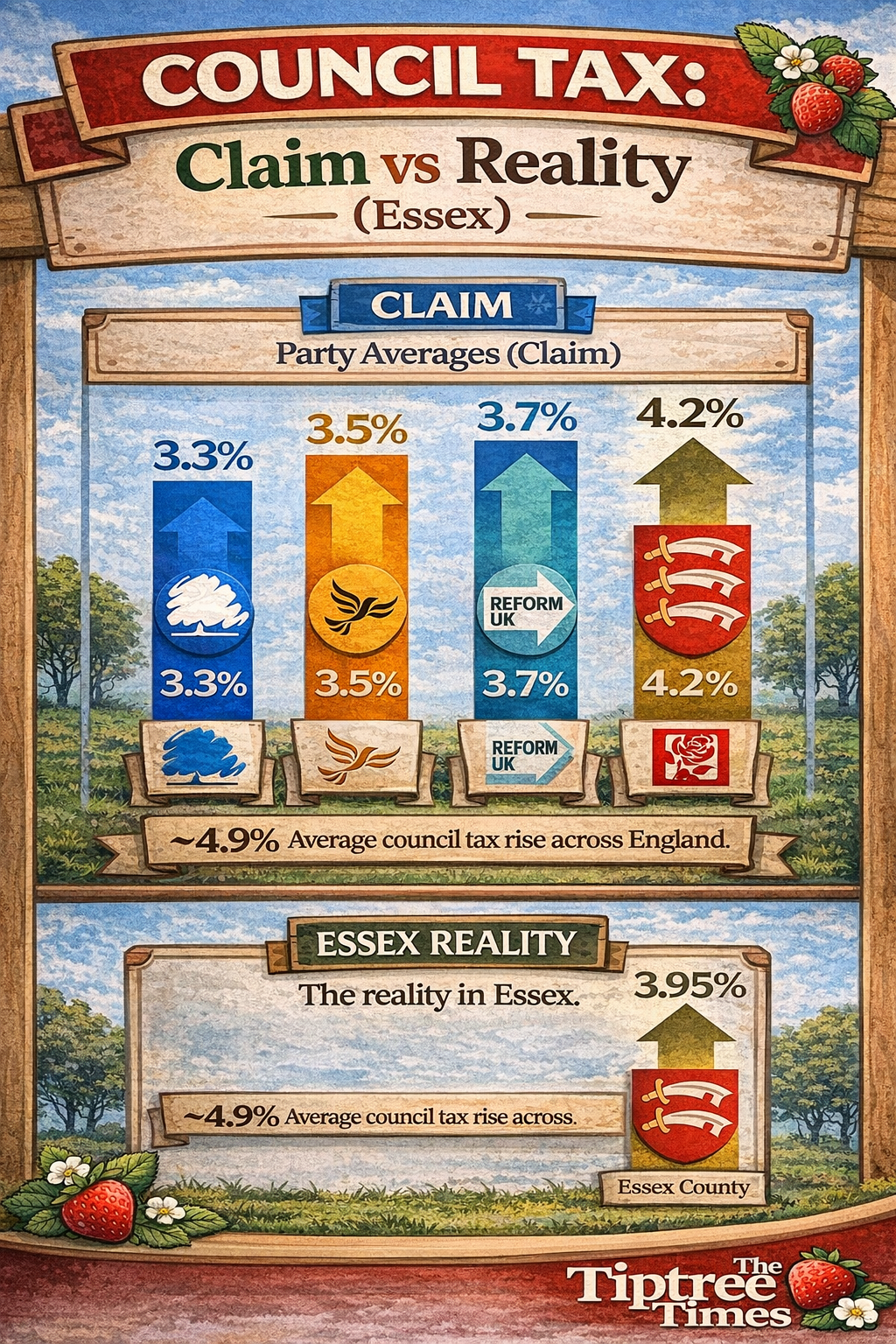
A graphic shared online, including by local Conservative figures, claims that Conservative-run councils deliver the lowest council tax rises in England.
The figures suggest average increases of:
- Conservatives: 3.3%
- Liberal Democrats: 3.5%
- Reform UK: 3.7%
- Labour: 4.2%
The claim is based on Band D council tax data for 2026–27, using analysis attributed to government figures.
What the data shows
The figures are based on real underlying data, but represent party-analysed averages rather than official like-for-like comparisons.
Across England:
- The national average increase is around 4.9%
- Most councils, regardless of political control, are increasing council tax by similar amounts
This is largely due to government rules, which mean councils can typically raise council tax by up to around 5% without triggering a local referendum.
The Essex picture
Essex County Council, which is Conservative-run, has set a council tax increase of around:
3.95% for 2026–27
That places it:
- Below the national average
- But still within the same narrow range seen across much of the country
Why the averages don’t tell the full story
While the graphic compares averages by political party, council tax is set locally, and varies depending on:
- Demand for services like adult social care
- Local funding pressures
- Population needs and growth
In practice, this means:
Residents across different areas, including those under different political control, are often seeing similar increases in real terms
How this links to our previous coverage
This follows on from our recent reporting on local political messaging, including claims and responses shared by councillors across Colchester and surrounding areas.
As with that coverage, we’re focusing on:
- What’s being said
- What the data shows
- And how it translates locally for residents
Putting the claim in context
The figures shared online are:
- Based on real data
- Presented in a political context
- Focused on averages rather than individual council decisions
For residents in Essex, the actual increase sits close to the national trend, rather than representing a dramatically lower rise.
🍓 The Tiptree Times take
This isn’t a case of one area seeing dramatically lower bills than another.
Instead, the data suggests most councils, including here in Essex, are working within the same financial constraints, leading to broadly similar council tax increases across the country.
Got a view?
Have you noticed your council tax going up this year?
Does it feel in line with what’s being claimed?
Let us know – we’re always looking to reflect real local experiences.






Leave a Reply