
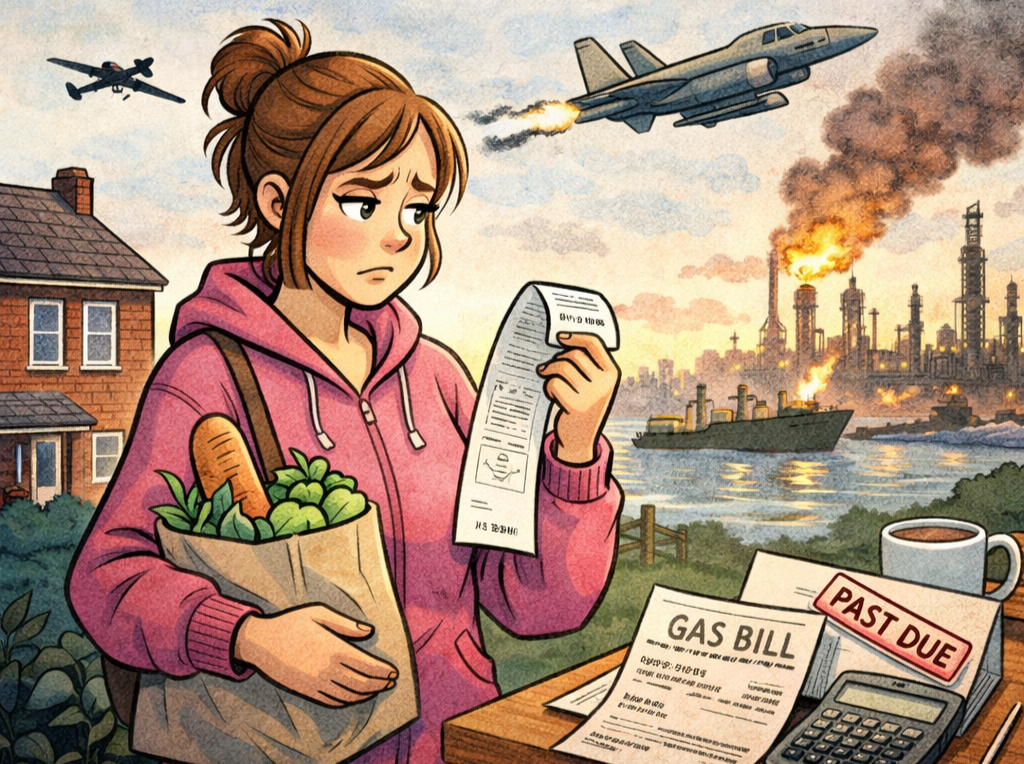
There’s a very specific moment that keeps happening lately.
You’re stood in the kitchen, staring into the fridge.
It’s not empty. Not really.
There’s just… nothing you can make into a meal without needing something else.
So you go to the shop. Again.
You pick up the same things you always do — bread, milk, something for packed lunches, something quick for dinner because everyone’s tired — and somehow, again, it comes to £60… £80… £100.
And you stand there, receipt in hand, doing that quiet mental maths:
“I swear this didn’t cost this much before.”
You’re right.
Meanwhile, somewhere else entirely…
On the news, there’s talk of Iran, America, missiles, oil routes, retaliation.
It sounds big.
Complicated.
Far away.
Easy to switch off from.
Because what does any of that have to do with a food shop in a small village, or a tired parent trying to get dinner on the table?
Quite a lot, as it turns out.
The part no one really explains
There’s a stretch of water most people have never heard of — the Strait of Hormuz.
It doesn’t look like much on a map.
But about a fifth of the world’s oil passes through it.
And right now, it’s right in the middle of rising tension.
When that area becomes unstable, even slightly, the cost of oil reacts immediately.
And oil isn’t just petrol.
It’s:
- the lorry that delivers your food
- the energy that heats your home
- the cost of producing and packaging almost everything you buy
So when oil prices twitch, everything else follows.
Quietly. Relentlessly.
“The UK isn’t involved”… technically
You might have heard that the UK isn’t at war.
And that’s true — officially.
But the reality is messier.
The UK supports allies.
It hosts military bases.
It has a presence in the region.
Which means we’re not in it… but we’re not untouched by it either.
And more importantly, even if we stayed completely out of it, the economic effects don’t ask permission.
They just arrive.
This is what it actually looks like at home
War doesn’t show up the way it used to.
There are no sirens.
No blackouts.
No clear moment where everything changes.
Instead, it looks like:
- Petrol creeping up again
- Your energy bill refusing to go down
- Your food shop getting smaller but costing more
- Your mortgage quietly increasing in the background
It’s subtle enough that you question yourself.
“Is it just me being bad with money?”
“Am I overthinking it?”
You’re not.
The bit we don’t talk about
There’s also something else.
A kind of low-level, constant tension.
You see headlines. You half-read them while making dinner.
You scroll past words like missiles, retaliation, conflict.
And then you go back to normal life — school runs, laundry, trying to remember if you’ve defrosted something.
But it sits there, in the background.
Especially when you’ve got children.
Because suddenly “far away” doesn’t feel quite so far.
So why does this matter here?
Because people deserve to understand what’s happening to them — not just what’s happening in the world.
This isn’t about politics.
It’s not about picking sides.
It’s about joining the dots.
About realising that:
- global conflict doesn’t stay contained
- economic shockwaves travel fast
- and ordinary families feel it first
The quiet reality
War doesn’t always arrive loudly.
Sometimes it arrives in small, forgettable moments:
- tapping your card and hoping it goes through
- putting something back on the shelf
- choosing what you can do without this week
£3 here.
£5 there.
Every single shop.
Until one day you realise everything costs more…
…and no one ever really explained why.




Leave a Reply